
Nick Winter
The Theft of the Mona Lisa
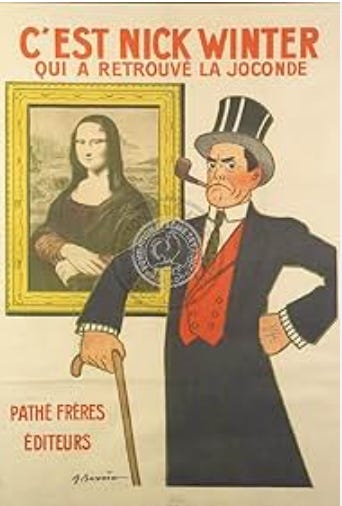
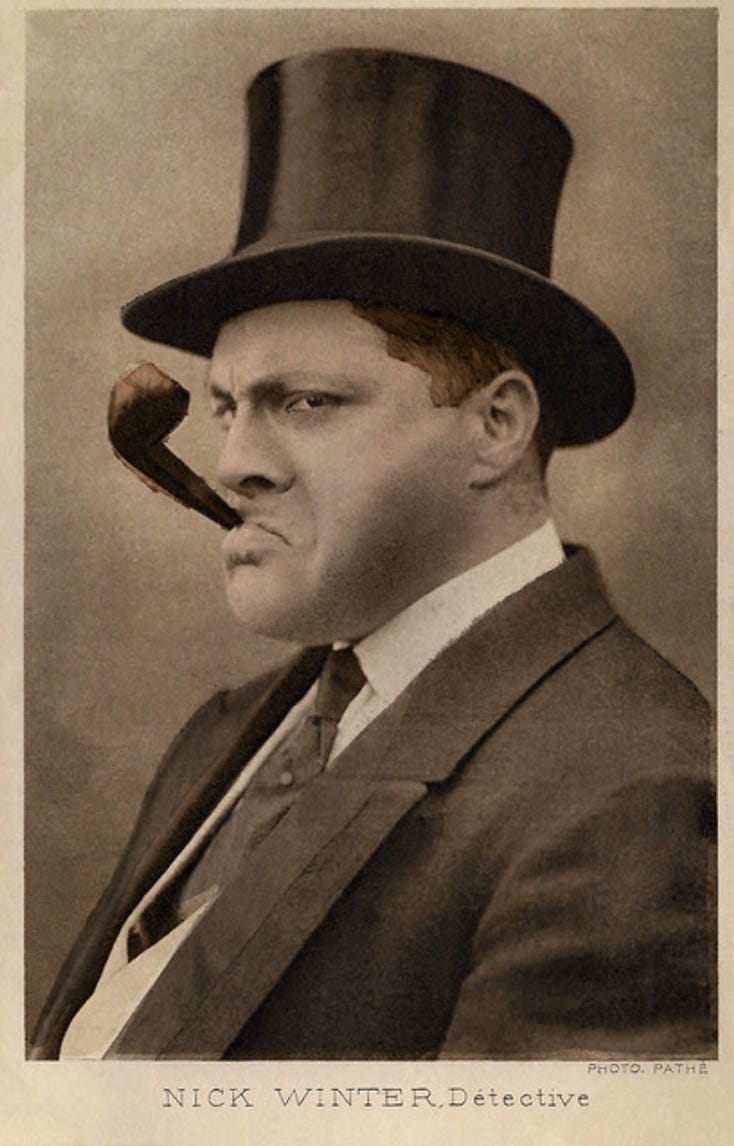
G’day friends. Happy New Year to you all. I’m starting 2026 small. Or should I say ‘short’. The first film I watched this year was the short silent film, Nick Winter et le vol de la Joconde—Nick Winter and the Theft of the Mona Lisa. The film stars Georges Vinter, who, between 1910 and 1921, appeared in numerous adventures as detective Nick Winter. Winter was sort of a French comedy version of Sherlock Holmes. I’m not sure exactly how many films there were in the series because each of the films was released in different territories under different names. For example, La résurrection de Nick Winter was released in Australia (the films were very popular in Australia, particularly Queensland) as The Resurrection of Nick Winter, Nick Winter and the Petrol Bandits, and The Petrol Pirates.
Nick Winter is pretty much forgotten now, existing as barely a footnote in the history of detective cinema.
Nick Winter et le vol de la Joconde (1911)
English Translation: Nick Winter and the Theft of the Mona Lisa
Directors: Paul Garbagni, Gérard Bourgeois
Actors: Georges Vinter
Nick Winter and the Theft of the Mona Lisa is the most accessible episode in the 30+ series of French silent films. It can be found online. If you’re curious—I’ll post a link below. At only ten minutes in length, the plot isn’t overly complicated, and the humour is of the broad slapstick kind.
The film begins early in the morning, at the home of the Directeur du Musée du Louvre. He’s awoken by his manservant, who has an urgent telegram from the famous detective Nick Winter (Georges Vinter). The telegram states that Mona Lisa has been stolen, and the director should join Winter and other members of the Sûreté at the museum.
The director leaps out of bed and hurriedly dresses. In his haste, he snaps part of a shoelace and fails to put on his braces correctly.
Upon arrival at the museum, the remaining portion of the director’s shoelace works free. He also notes his braces hanging loose. He unfastens them and places them on the floor out of the way.
With a magnifying glass, Nick Winter scrutinises every inch of the crime scene. On the floor, adjacent to the blank space where Mona Lisa once hung, he finds a piece of shoelace. And further afield, he finds a set of discarded braces. He immediately suspects these items belonged to the thief. You know where the story is heading, right?
Armed with this information, Winter sets about finding a man missing a shoelace and braces. Out of the street, he pays a shoe-shine vendor to switch clothes with him and for the use of his kit. He then examines the shoes of the men in the vicinity, hoping to find a man without a shoelace.
When Winter has no luck, he returns dejected to the museum. But there, he discovers the director is missing a shoelace and braces, and deduces that he must be the thief. A scuffle breaks out as Winter tries to have him arrested.
During the commotion, the real thief returns to the museum with the Mona Lisa. He returns it and steals another painting in its stead. He also leaves a note stating that he is short-sighted and had stolen the wrong painting.
Nick Winter et le vol de la Joconde is very clearly capitalising on the real-world theft of the Mona Lisa, stolen by Vincenzo Peruggia, which occurred on 21 August 1911 and instantly became an international media sensation. After the theft, the space where the painting had hung remained empty for years, and it wasn’t recovered and returned to the Louvre until 1913. I guess you could say Nick Winter et le vol de la Joconde was an early exploitation film.
If you’re interested in watching the Nick Winter et le vol de la Joconde, you can find it here. It’s under 9:30 seconds long.
Yours in the Spirit of Adventure
David Foster is an Australian author who writes under the pen names James Hopwood, A.W. Hart, and Jack Tunney. Under the latter, he has contributed three titles to the popular Fight Card series. His short fiction has been published in over 50 publications worldwide, including by Clan Destine Press, Wolfpack Publishing, and Pro Se Productions, to name but a few. In 2015, he contributed to the multi-award-winning anthology Legends of New Pulp Fiction, published by Airship 27 Publishing.
Foster’s non-fiction work appeared in the award-winning Crime Factory Magazine, as well as contributing numerous articles exploring pulp fiction in popular culture to Girl Gangs, Biker Boys, and Real Cool Cats: Pulp Fiction and Youth Culture, 1950 to 1980 (2017, PM Press) and Sticking It To The Man: Revolution and Counterculture in Pulp and Popular Fiction, 1950 to 1980 (2019, PM Press). He has also contributed articles on the ANZAC war experience to Remembrance (2024, Union Street 21).
Foster lives in the old Pentridge Prison complex, behind high grey stone walls, in inner-suburban Melbourne, Australia.
Pl h
This was way cool... Great niche trivia...